Getting Out of Your “Comfort Zone” in Eating Disorder Recovery

In this article
This article was written by Maeve Hanan, Eating Disorder Specialist Dietitian and Founder of Dietetically Speaking.
Why Disordered Eating Can Feel Safe
When you have an eating disorder or struggle with your relationship with food, disordered eating can feel like a sort of “comfort” zone because it can feel safe and familiar. For many it brings a sense of control when other parts of your life may feel out of control.
But this familiarity isn’t the same as actual safety.
It’s a false sense of control. In reality, you actually lose control to the eating disorder. Your physical, mental and social wellbeing suffer and your life often becomes very small.
Why Eating Disorder Recovery Can Feel Scary At First
When you start to challenge disordered eating it can feel scary in the beginning as you’re moving away from that eating disorder “comfort” zone while you challenge food rules and test new behaviours and coping tools.
Heightened anxiety at this stage is absolutely valid, and it’s a normal part of the process. It’s necessary to sit with discomfort until new habits start to feel safer and more ingrained. Don’t forget that you don’t have to do it alone. Having the right support in place can make this stage feel much more manageable.
Why Facing Eating Disorder Fears Is Worth It
Working through the initial fear and discomfort as you start to challenge eating disorder behaviours is so worthwhile, as it’s a vital step towards full recovery where ultimately:
- Food no longer rules your life
- You feel a lot better in your body and treat it with respect
- You’re healthier and happier
- You have more time and headspace for things that you enjoy and that bring your life meaning
I’ve never met anyone who has regretted healing their relationship with food, and I’ve seen countless times how life-changing it is.
Recognising the Eating Disorder “Comfort” Zone
I use this image to visualise the eating disorder “comfort” zone with my clients, as it helps them to make sense of their experiences during recovery:
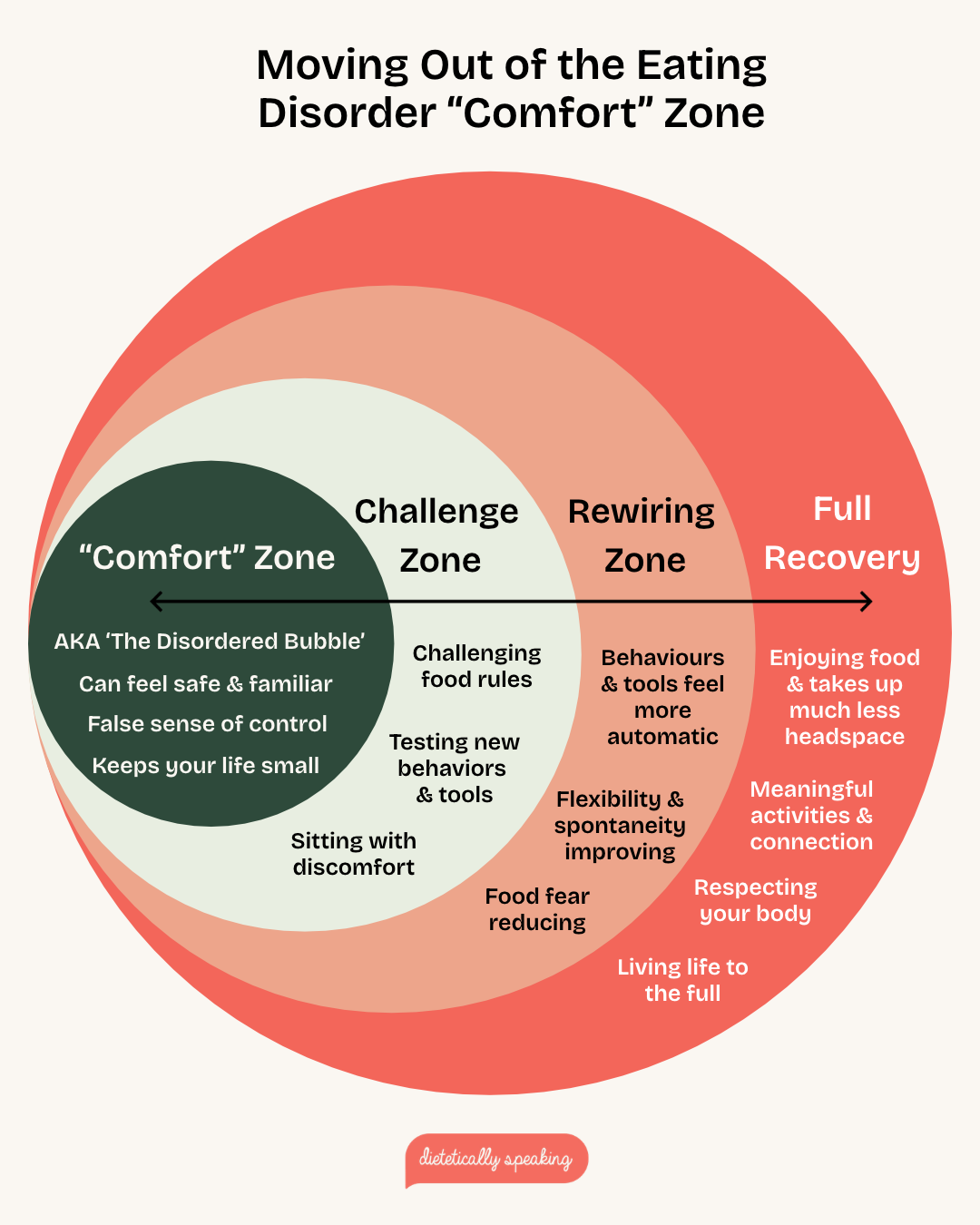
This shows why it can feel so enticing to remain with the eating disorder at times, even when you logically know this isn’t good for you. It can also help to explain why the eating disorder part of you can get really loud or anxious when you take, or even consider taking, significant steps towards recovery. That’s because these recovery-aligned moves feels far out of the eating disorder part’s “comfort” zone.
Eating Disorder Recovery Isn’t a Straight Line
The arrow in the zones of eating disorder recovery image very intentionally goes in both directions, as recovery is rarely linear. You can absolutely move in and out of these zones at various stages of recovery, and it can be helpful to be able to identify when this is happening.
If you’re struggling with an eating disorder or your relationship with food and you want compassionate, expert support, you can set up a free discovery call with one of our wonderful Eating Disorder Specialist Dietitians.